
The Mysterious Artists Behind Sicily's Norman Mosaics
When I traveled to Sicily for the first time, I was excited about all the usual things that attract people there: the weather, the food, picturesque villages, and the beautiful azure water. But for me, there was one particular thing I wanted to see above all else: the medieval Norman-era churches in Palermo.
Why do some medieval churches feel so fascinating to me, you might wonder?
For starters, there are some captivating facts about them. They are over 800 years old and were commissioned by kings who ruled Sicily but, strangely enough, were descendants of Vikings. What they achieved is astonishing in scale and artistry, yet we know very little about the artists who created these works, as history has not preserved their names.
What we do know is that the artistic style echoes that of an empire largely forgotten today, but one that was a great center of civilization for an astonishing 1000 years: Byzantium.
As a child, I lived in Turkey, and many of my early memories involve my parents taking me to old, ruined places that bore traces of this civilization, which I did not fully understand back then. Years later, however, I developed an affinity with the Byzantines. For me, it is a window to a time long past, filled with wonders - both my childhood and their civilization.
So, whistling the Indiana Jones soundtrack in my head, I embarked on this journey into the distant past to see what and whom I might meet there.
![]() Cefalù Cathedral. The exterior is so restrained that you could almost walk past it. But don't judge the church by its cover!
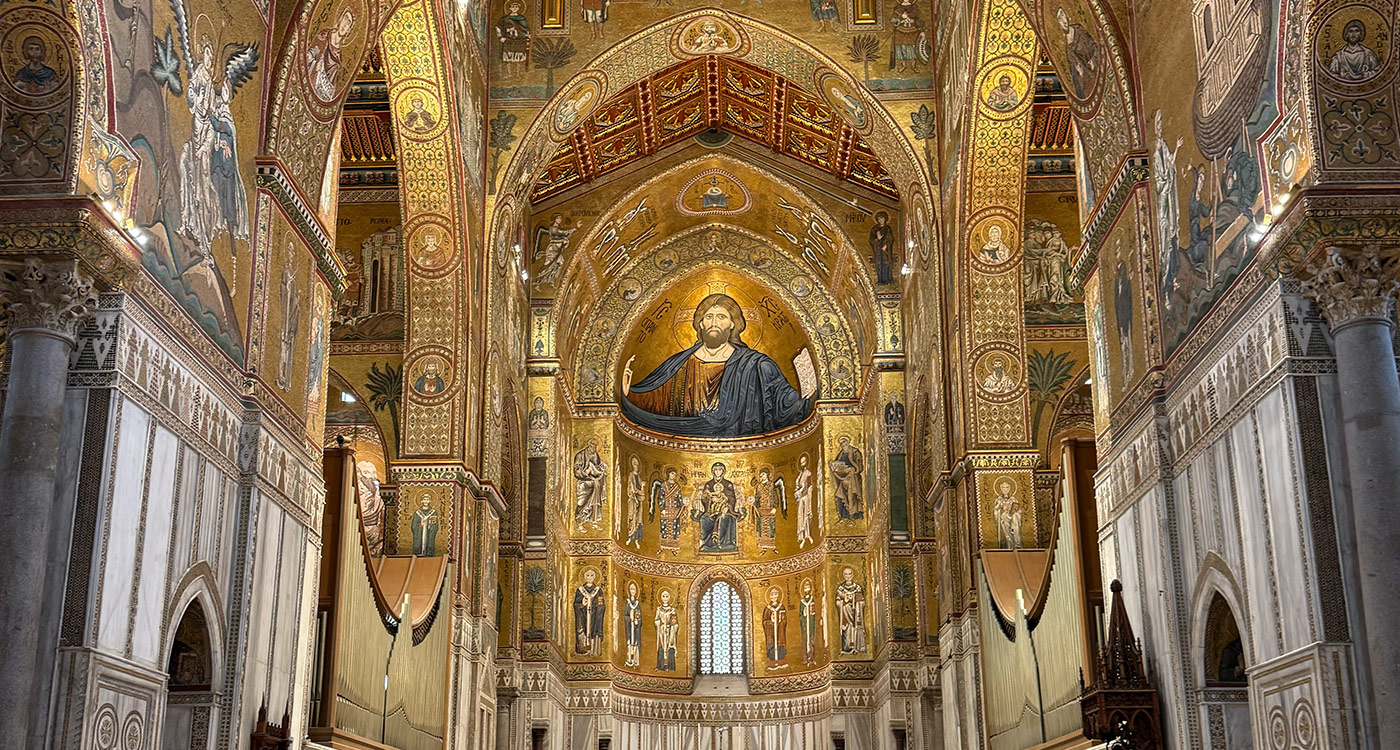
![]() Monreale. It's only when you step inside that the sheer scale of the artwork becomes apparent. Every wall is covered in mosaics.
![]() La Martorana. Every church places a massive figure of Christ at its center, set against a gold background that catches the light from every angle.
![]() In Monreale, the mosaics don't stop at the apse. They wrap around the entire church, turning the walls into a vast illustrated Bible. Something like a medieval comic book.
![]() Photos capture the mosaics, but it's much harder to capture the experience. The gold shimmers in the light of the sun and candles, making the entire church seem to glow.


Origin
Art historians made some educated guesses about who created those mosaics and where they came from. Most of them point to one place - Constantinople, the capital of the Byzantine Empire. It was the greatest city of the medieval world and a major center of art and trade, much like New York or Los Angeles are today.
The artistic quality of the mosaics suggests that their creators must have been highly skilled craftsmen. They likely traveled across the Mediterranean and were hired by kings and bishops to work on important religious monuments, which leads me to believe they enjoyed a certain reputation.
I moved from Poland to Sweden and then to the US in pursuit of ever more interesting and prestigious projects. My specialty was interactive design, and I worked for many advertising agencies that also cared a great deal about craftsmanship. Large corporations - the modern counterparts of kings and bishops - would hire us to create campaigns for their products based on that reputation.
Even if I can't say for sure whether their motivations were similar to mine, I can imagine that some medieval version of a pursuit of creative excellence must have been part of it.
Craft
While contemplating these works of art, I found myself thinking less about their religious meaning and more about the process behind making them. I wondered if the mosaics came to life through a process similar to modern creative design.
Think about it: someone had to sketch them out and get approval from the patron. Then came the real challenges: balancing proportions, adapting the images to curved ceilings, finding the right colors, and placing tile after tile so the whole composition would come alive. It required not only technical mastery but also constant creative thinking and problem-solving.
![]() Christ Pantocrator appears in countless Byzantine churches, yet what fascinated me wasn't the iconography or the religious theme, but the craftsmanship. The shading of the face and robes reveals artists who deeply understood how light, color, and geometry combine to create the illusion of three-dimensional form.
![]() This close-up reveals the remarkable balance between craft and artistic vision. Each individual tile had to be placed with care, yet the artist never seems to lose sight of the image as a whole.
![]() This John the Baptist may be one of the most depressed-looking people I've ever seen in a work of art. The rows of glass tiles reminded me of brushstrokes in an Impressionist painting. Up close, they're just individual pieces, but from a distance they come together to create a face full of emotion and character.
![]() Saint Procopius. Even in a figure this small, just a handful of glass tiles is enough to suggest the folds and depth of his robe. I was equally impressed by the lettering above—clean, evenly spaced, and carefully proportioned. Nine centuries before digital fonts, someone was already paying close attention to typography!
![]() This may be my favorite detail. Instead of stopping at the stone column, the mosaicist decided to recreate its Corinthian capital in glass. It feels almost playful! As if - having so completely mastered his craft - the artist challenged himself to see whether he could imitate sculpture using nothing but colored tiles.
![]() Most of the mosaics are high above the floor, making them feel almost impossibly perfect. At eye level, however, you begin to notice the tiny imperfections. Rather than diminishing the work, they make it feel human. A reminder that every tile was placed by hand.
![]() Roger II, the king who commissioned these mosaics, is depicted being crowned by Christ himself. The urge to cultivate a larger-than-life public image didn't begin with modern billionaires. It was already alive and well in the Middle Ages.
![]() The cloister next to the Cefalù Cathedral. After all the gold and opulence inside, this felt like the perfect place to slow down and gather my thoughts.


Gazing at the impressive mosaic of Christ Pantocrator in Cefalù Cathedral, I wondered how passionate these artists were about what they did. Many times, I worked on projects where I, quite frankly, disliked my clients or had little interest in the particular campaign or product. But I could still find my motivation in the art itself. I would spend hours perfecting the spacing of a layout or polishing a little interface animation.
Was the experience similar for them, too? I can't know what they thought of their masters or the religious themes they depicted. However, the details - such as facial expressions or the folds of clothing - reveal an attention to detail that, in my experience, is not possible without a deep dedication to the craft.
At that moment, the mystery of their origins and the enormous amount of time separating us seemed to disappear. I imagined them walking out after a hard day's work and felt that I could join them. We could sit down, grab a glass of wine by the sea, and nerd out on creating beauty with the tools at hand - be it computer code or ceramic tiles. I'm pretty sure we'd have a fun and inspiring conversation!